Tuesday, January 20, 2009
Thursday, January 08, 2009
Our moral solar system
And I've been thinking about the paradoxical challenge of explaining that mechanism to people who, apparently, do not perceive harm. I'm still working on that.
Meanwhile, Jon Haidt and his colleagues at the University of Virginia have been examining the foundations of morality that our species has evolved, along with the interactions of our evolved foundation with our cultural programming. Haidt's model, which I find useful, suggests five foundations of "intuitive ethics".
The first of the five is "Harm". That grabbed my attention. As I thought about the other four items in Haidt's list, I found myself thinking repeatedly,
"Isn't that also a form of harm?"
I noticed, too, that Haidt and his associates acknowledge that their model may be wrong, even though they find it useful. That grabbed my attention, too, of course. They've cheerfully offered a reward to folks who may suggest improvements. In the fine print of their challenge they compare the task to identifying planets in our solar system, and to the challenge of distinguishing planets from other large rocks, with a nod toward former planet, Pluto.
Thinking about the solar system, about what constitutes a planet, and about what constitutes harm, led me to a modification of Haidt's description that works better for me. I think of the concept of Harm as the crucial, unifying component of Haidt's model of moral foundations. Harm, to me, represents the sun, the center of a moral solar system. The other four planets, Fairness, Loyalty, Respect, and Sanctity revolve around it. They all relate to Harm. They involve harm, in differing ways. Those other moral components are captured and orbit in the same system because Harm exerts far greater gravity upon them.
One aspect of harm, and the perception of harm, that I've been thinking about involves anticipation of future harm. Beyond recognizing a clear and present immediate danger, our ability to predict harmful consequences — or not — seems to me one of our greatest challenges as a society.
That predictive anticipation is one way that those other four components relate to harm as a central, unifying framework. Consider Fairness, for example. I hope it's obvious that it would be unfair to withhold food from me if I'm starving. But what about something smaller? What about when someone cuts in front of me in line? Or more often, while driving? On those occasions the annoyance of being treated unfairly usually passes quickly. The greater question for me, however, is to wonder what other ways a socially unfair driver or line-jumper might behave in the future? If I can't trust someone to make a wise, fair decision about a small action, how can I trust such a person to make a wise, fair decision about something bigger, something more threatening, something more harmful? It's the warning alarm about future harm that unfairness raises in my mind.
Haidt's group looks at loyalty in the context of groups. I'm not very good at group loyalty for its own sake. I'm a lousy sports fan. As a teenager, I never felt the appeal of "school spirit". Such arbitrary assignments of loyalty rarely include any sense of perceptible harm that inspires me. The well-being of the community where I live, however, affects my own well-being. My perception of current or future harm can, and does, inspire loyalty to my community.
Respect, for me, is another valuable predictor of future behavior. There may be immediate psychological benefit, or harm, if someone does or does not respect me. Like fairness, however, my greater concern is for the future. People who respect me now seem more likely to ensure my well being in the future. People who disrespect me now (by treating me unfairly?) seem more likely to cause me harm in the future. Lack of respect is a warning alarm about the potential for future harm.
The last component, sanctity (paired with "purity" in Haidt's model) is "shaped by the psychology of disgust and contamination." Physical contamination, such as polluted air, polluted water, or spoiled food, clearly relates to potential physical harm.
So when I think about Haidt's model, I see the concept of harm as an underlying theme. I see the concept of harm as a unifying framework. In our moral solar system, I see our ability to perceive harm in all its forms as the sun whose gravity binds other moral components into a cohesive system.
Am I saying Haidt's model is wrong? Not necessarily. I find it more useful to think about harm as the key component because that suits the persuasive work that I do. I encourage folks to see a bigger picture. It's been my experience that finding one key item to focus upon can help other people see a bigger picture. Placing the perception of harm at the center of our moral solar system works better for me, for what I want to do. What Haidt's group wants to do is examine the interaction of our moral foundation with our culture and with our public policy decisions. And they need to measure those interactions somehow. For their purpose, collapsing the entire model to emphasize harm might make it more difficult for them to measure the interactions they seek to describe. My model of our moral solar system may not work as well for them as it does for me.
Most models are wrong, but some are useful.
Some models are wrong and useful in different ways, at different times, for different people, with different purposes.
This piece added by
etbnc
at
1/08/2009 06:15:00 PM
3
comments
Monday, November 17, 2008
Six sides of dice, and mature engagement with reality

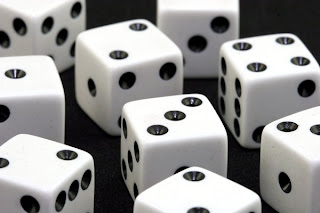
Dice are familiar objects, right? Little cubes that fit in your hand, numbered one through six with decorative dots.
Think about one of them. One die, strange as the singular name seems. Which of its six sides is most important? Which of the six numbers is most important?
Well, it really depends on the game, right? And without the context of some particular game, no side is more nor less important than the others. All six sides are facets of the whole object. Dice wouldn't be dice without all six sides.
People sometimes ask me what I think is the most important aspect of sustainability. What's the most important problem? What's the most urgent? What's the one thing that worries me most?
Like identifying the most important side of a die, the answer varies. My answers to such questions vary from day to day, from conversation to conversation, depending upon the context. But there are some recurring themes.
When I try to explain the recurring themes I sometimes suggest a visual metaphor. So far, the best visual metaphor I've found comes from those six sides of dice.
So here's a list of things I consider crucial to achieve a sustainable culture. Like the sides of dice, these are all facets of a whole. No one of them is necessarily more nor less important than the others. They're all related. I won't number them nor rank them. I just list them in some order that seems convenient and flows, like this...
- empathy
- ability to perceive harm
(even subtle harm) - ability to anticipate consequences
(outcomes both good and bad) - maturity
(regardless of birthdays) - healthy engagement with the real universe around us
- ability to learn
(especially from mistakes and unexpected outcomes)
Conservation is important. Recycling is important. Economic justice is important. Of course!
But all of those important things result from our human interactions: our human interactions with each other, and our human interactions with the real universe that surrounds us.
Sustainability is about attitude. Sustainability is about culture. Sustainability is about empathy, and maturity, and the ability to perceive harm in all its forms. Sustainability is about anticipating consequences. Sustainability is about anticipating harm. Sustainability is about learning from our mistakes. Sustainability is about seeing the real universe and engaging reality as healthy grown-ups.
Sustainability is about all of those things, and a lot more. But that seems a good start.
---
In his own way, Professor George Mobus addresses many of these sides of the dice at his blog, Question Everything.
Photo courtesy of Designs by Darren.
This piece added by
etbnc
at
11/17/2008 09:32:00 PM
1 comments
tags Key pieces
Tuesday, August 26, 2008
Do you know why Indian rain dances always worked?
Because the Indians would keep dancing until it rained.
And that is why I like to read what Sherman Alexie writes.
This piece added by
etbnc
at
8/26/2008 03:15:00 PM
0
comments
Monday, August 04, 2008
Wisdom looks toward the future
These days people seek knowledge, not wisdom.
Knowledge is of the past;
wisdom is of the future.
Lumbee elder
Perhaps this puzzle piece connects to another from two years ago: Information, Knowledge, Wisdom
Wisdomkeepers: Meetings with Native American Spiritual Elders
This piece added by
etbnc
at
8/04/2008 05:26:00 PM
1 comments
tags Books, brief thoughts
Monday, April 14, 2008
Troll Spectrum Behavior (version 1.0)
Now, trolls and trolling have a long history on the net. (And in the context of accelerated "Internet time", that's saying something.) Originally the terms "troll" and "trolling" described a kind of deliberate and conscious game. More recently, however, a number of folks have noticed -- and by noticed, I mean, cursed about -- the appearance of people who behave like trolls but who seem to have no insight into their behavior. It's that aspect of the current phenomenon that I think of as "Troll Spectrum Behavior". It seems there's a remarkable number of folks whose uninhibited online behavior is functionally indistinguishable from the old games of trolling for newbies and trolling for suckers. Many of these folks seem to be flying on autopilot, operating "open loop", not learning and thus not communicating.
Since the Legos are already scattered all over the floor, I might as toss these pieces onto the pile. These pieces are from comments at ScienceBlogs.com. First a question posed by another participant:
Here's a question -- is it real trolling if the person actually holds that attitude, or is it real trolling if the person doesn't hold that attitude in reality, but pretends to just in order to get people wound up? Or, are both of those "real trolling", just different flavors?
My reply:
I put "real trolling" in quotes to parallel your earlier use of quotes and to suggest a pun on the commenter's nickname.
But raising a question about the psychology of trolls does strike me as relevant to the original topic. As I recall from back in the days of Internet yore, early on the terms "troll" and "trolling" supposedly signified game-playing behavior, a kind of sport, or sometimes performance art. But it seems to me that was a flimsy cover story from the start. The behavior was unhealthy then and it still is now.
As you suggest, these days I don't really try to distinguish trolling as a supposed game from functionally equivalent harmful behaviors. When Troll Spectrum Behavior occurs, I do think it's important that someone demonstrate a healthier counterexample. Accidental quasi-trolls might learn if offered an opportunity, and some healthy social reinforcement helps to maintain a sense of community. Beyond that, of course, no feeding. :)
It seems to me Troll Spectrum Behavior might be related to a problem that I see underlying the topic of Zuska's post, and that I see underlying a number of social problems: a widespread inability to perceive harm.
Filtering out perceptions of harm, injustice, exploitation, pain, and suffering; lacking empathy or actively suppressing empathy; ignoring the consequences of our behavior; these things seem like enablers in mechanisms that create further harm. I find that disturbing.
About the same time, the topic came up at another blog within the ScienceBlogs umbrella. There I wrote:
I find no value in trying to distinguish the varieties of Troll Spectrum Behavior (as mentioned recently at Zuska's blog). It doesn't matter to me whether attention-seeking and game-playing behaviors stem from conscious or un/subconscious motivation. The consequences are pretty much the same, so my (lack of) response is pretty much the same.
I do think it's important to demonstrate mature interactions instead. That fosters situations in which social learning can occur. But that doesn't require feeding attention appetites.
(This is a rough draft. Proper links forthcoming...)
This piece added by
etbnc
at
4/14/2008 05:28:00 PM
2
comments
Friday, April 04, 2008
Communication involves learning
The knowledge to be gained might be just a tiny tidbit, as little as, "What's at the end of this very sentence?" As trivial as that may seem, if we read, or listen, wait patiently for the end of that sentence to arrive, and attempt to comprehend it, we discover new information there. If we accept the existence of that new information, we can learn.
We don't even have to agree about the meaning of that new information. If we merely accept the existence of new information, we might learn. We might communicate.
If we are not open to the experience of learning, if we are averse to new information, how can we expect to communicate?
Communicating involves learning. It seems to me our ability to communicate is closely related to our willingness to learn.
This piece added by
etbnc
at
4/04/2008 10:22:00 AM
2
comments
Tuesday, April 01, 2008
This is not a new post
Looking at the calendar today, and looking at some of my usual daily web site reading, I am reminded that today is not a good day to try to be serious.
Since I try to emphasize serious, weighty matters here, I definitely will not post anything new today.
Definitely. Not.
Um, er, what? Oh, I see. Doh!
This piece added by
etbnc
at
4/01/2008 10:29:00 AM
0
comments
Wednesday, March 26, 2008
Words to think by
Understanding is a kind of ecstasy.
This piece added by
etbnc
at
3/26/2008 09:56:00 PM
0
comments
tags brief thoughts
Removing barriers to understanding
How do we become motivated to understand?
How do we become interested in understanding ... oh, I dunno, any idea, something, anything?
How do we become interested in learning?
The words "persuade" and "influence" are in that pile of Legos I dumped on the floor recently. The question, "How does persuasion work?" is one of the underlying themes of my writing here. It seems to me we often think about persuasion as an additive process. We provide facts, figures, and information. We build a case. Sometimes we try to make the process overwhelmingly additive. We blast information from a fire hose. We try to bury each other under piles of words.
This just occurred to me now, while writing this post: Sometimes persuasion seems more like a process of elimination, a process of removing barriers.
Sometimes (perhaps often?) persuasion occurs when we remove barriers to understanding.
So maybe we should ask ourselves the question this way:
How do we remove barriers to understanding?
This piece added by
etbnc
at
3/26/2008 04:25:00 PM
0
comments
Friday, March 21, 2008
Scattering many pieces, dumping my bucket of Legos
When I was a kid I often built things from Lego blocks. I kept my unassembled Legos in a gallon-sized plastic bucket. Whenever I began a new Lego building project, I would sit down and dump the entire bucket of blocks all over the floor in front of me. Scattering a gallon of Legos takes up considerable floor space, but it seemed the easiest way to find the pieces I wanted to assemble. That, and they made a satisfying whoosh, roar, and clatter as they tumbled out.
I knew folks who took a similar approach to assembling large picture puzzles. I have several essay projects that I intend to construct here eventually. Since I consider this blog as a staging area for my other web site, I thought it might be helpful to dump my bucket of Legos here so that we can easily find the building blocks for future essays. So, here we go: (Whoosh! Roar ... clatter)
Strategy
Tactics
Probably not.
But it can be difficult to perceive the difference.
projection
locus of control
in-group / out-group
Lord of the Flies
self-esteem
We all believe we're doing the right thing at the time we do it.
People who say they are "open-minded" usually are not.
People who say, "My door is always open", often say they are also open-minded.
People who say, "You don't have to like me, you just have to respect me" don't really know how liking or respect actually work.
memes
On the Internet, nobody knows you're a dog.
On the Internet, nobody knows if you're a 14 year old boy.
Or a 40 year old man.
Or 40 going on 14.
Nobody knows -- but one often suspects.
mature
becoming aware
conscious participation
Trying not to participate is a form of participation.
The most basic task of every human is to be human.
Everybody thinks those two statements make them look good.
open door
Defending a castle of belief
Swimming in a lake of information
Understand
Profess
Persuade
economic theory
economic reality
Kurt Vonnegut's Galapagos
high-maintenance beliefs
low-maintenance beliefs
habits
attitudes
habits
decisions
behaviors
Strict Father
exploitation
abusive relationships
disparity by design
altruism
prosocial behavior
evolutionarily stable strategy
Ants know how to live like ants.
Bees know how to live like bees.
Some fish swim in schools, but they don't attend school to learn how.
Humans evolved as a social species.
Look for a bigger picture.
There's usually a bigger picture.
connection
Gaviotas
tribe
Ethan Watters
What do the Amish understand that the rest of us do not?
voluntary simplicity
preventing involuntary simplicity
The Fifth Discipline
lessons from the beer game
control
power
influence
steering a sled
anthropology
psychology
climatology
learn the rules of the game
see the mechanism
then turn the system inside-out
possibility
confidence
imagination
probability
unintended consequences
Be careful what you wish for.
Experience is what you get when you don't get what you want.
Policy makes a poor substitute for sound judgment.
We probably look pretty silly from the point of view of an anthropologist from Mars.
This piece added by
etbnc
at
3/21/2008 01:15:00 PM
0
comments
Thursday, February 28, 2008
A sustainable culture begins with a healthy, sustainable attitude
What I fear is that some writers are trying to inspire a movement to actively cause a hard collapse
How would we live if beginnings justify means?
Thing is, for all the talk about big ideas and grand plans, what I notice, what a lot of folks notice, what we respond to, is consistently demonstrated behavior. Show me, don't tell me.
When I look around and find healthy, mature people who interact in healthy, stable social groups, I don't see a lot of attention-seeking behaviors. I don't see guys jockeying for position in the pack. I don't see competition to be declared smartest. Nor loudest. No one-upping. No tantrums. Nor do I see people who try to drag everyone around them into a black pit of despair. When I see healthy, mature people interact with each other in healthy, stable social groups, I see people who seem to share and appreciate a sense of community. I see people who become energized by mutually supportive, win/win, interactions. I see people who can see beyond themselves.
Of course, some big ideas and grand plans do overlap with attitudes and values that result in real, beneficial pro-social behavior. I'm happy to support those ideas and those plans. I strive to credit folks for imagination and innovation. But I refuse to endorse egotistic behaviors that cause harm to others. I refuse to endorse obnoxious behavior even if it's affiliated with someone's good idea. I refuse, because authentic, sincere prosocial behaviors actually create a healthy society.
Show me, don't tell me.
——
Some additional pieces that may fit:
Beyond Civilized and Primitive, Ran Prieur
Ideas, wrapped in behaviors
Circle of observers
Two questions
Being a good person despite bad outcomes
Tip of the iceberg
To be wise is to see
Arithmetic allegory #4
(links open in a new window or tab)
This piece added by
etbnc
at
2/28/2008 07:15:00 PM
6
comments
Misery creates company
Misery loves company.
Often, misery needs company.
Too often, misery creates company.
And that's a problem, don't you think?
This piece added by
etbnc
at
2/28/2008 02:00:00 PM
0
comments
tags brief thoughts
Wednesday, February 27, 2008
Show me, don't tell me
Some people like to stand on soapboxes and shout loudly at me. They like to proclaim that they have my best interests at heart.
Personally, I prefer consistently repeated behaviors by people who demonstrate that they have my best interests at heart.
Just sayin'
This piece added by
etbnc
at
2/27/2008 01:56:00 PM
0
comments
tags brief thoughts
Tuesday, February 26, 2008
Good writing, assembling important pieces, elsewhere
He was constantly reminded of how startlingly different a place the world was when viewed from a point only three feet to the left.
(Douglas Adams)
Most models are wrong, but some are useful.
(George Box, paraphrased)
I found Prieur's essay intriguing and well worth reading. Overall his assembled puzzle seems to look similar to mine (although he does include a few pieces that aren't part of my outlook). Most importantly to me, Prieur's essay synthesizes an attitude about our future that I consider beneficial. (Some models are useful!)
I've also recently encountered the online publication of Greater Good, a project of the Greater Good Science Center at UC Berkeley. The latest issue explores the psychology of power and influence in several insightful articles. One of them, in particular, provides some further background to Prieur's essay: Political Primates
There's some good writing, and good reading, out there.
Enjoy.
This piece added by
etbnc
at
2/26/2008 07:20:00 PM
0
comments
Friday, February 01, 2008
Idealism. Labelism. Bagism.
If it ends with -ism it seems likely to become a problem, for someone, someday.
That's been my observation and experience.
Ideologies. Labels. Imaginary boundaries. Is. Is not! An illusion of information.
We bundle up some things we know believe, slap a label on the bundle, and talk as if everything worth saying can be delivered in a bag with a label. Eventually Later Soon we begin to talk as if only the label matters, as if everything we need to know can be conveyed merely by the label. Sometimes we seem to forget what we put in the bag, we're so busy announcing its label.
I thought about calling that phenomenon “bagism”, but someone else got there first. Same with labelism. Even ismism.
Good grief, what's left?
Well, how about breaking that habit?
This piece added by
etbnc
at
2/01/2008 09:21:00 PM
1 comments
Wednesday, January 23, 2008
Ideas, wrapped in behaviors
(Some thoughts under development ... )
Ideas, when they form and float through our minds, are just ideas.
Expressing ideas, the act of communicating, is behavior.
We like to believe that our writing, our speaking, our conversations, we like to believe we deal only with ideas. But to me that seems incomplete. It seems to me we often react to the behaviors that we perceive as much or even more than the ideas wrapped in those behaviors.
Words matter. Words matter because words create consequences. Communicating with words is a behavior.
And behaviors create consequences.
See also:
Show me, don't tell me
and
A sustainable culture begins with a healthy, sustainable attitude
This piece added by
etbnc
at
1/23/2008 02:15:00 PM
1 comments
Saturday, January 19, 2008
Amusing Ourselves to Death
I've mentioned this book several times recently in comments elsewhere. It occurred to me that I should mention it at my own web site, too:
Amusing Ourselves to Death: Public Discourse in the Age of Show Business
by Neil Postman
If TV news and talk radio leave you feeling something other than well-informed, Postman's little book might explain why.
This piece added by
etbnc
at
1/19/2008 05:21:00 PM
1 comments
tags Books
Thursday, January 10, 2008
web log, with explosions and funny hats
Trinifar writes clear and concise, yet detailed, essays about sustainability concepts. Trinifar's writing path takes up where mine leaves off. The essay title, “Learning to think about the future”, would have made a good subtitle for my site. (Darn, too late, I guess.)
“Learning to think about the future” would also be a good subtitle for this video about climate change. The science teacher who began this YouTube effort a few months ago has refined his message. He sets an excellent example of clear and careful thinking about a challenging topic. He delivers an urgent and serious message, punctuated with explosions and funny hats.

(click to open this video in a new window or tab)
“While we debate ...
we're running the experiment ...
and we're in the test tube.”
soap and water; and
What does it mean to “just” get along?
This piece added by
etbnc
at
1/10/2008 10:10:00 AM
0
comments
Sunday, October 28, 2007
Circle of observers (rough draft)
Picture a group of people, a dozen or more, standing in a circle, looking outward. They stand shoulder to shoulder, backs to the center, facing away from each other.
Many of them have telescopes, some have binoculars. They all have clipboards and notebooks and lots of pens and pencils in the pockets of their white coats.
They look outward at the universe and declare proudly, "From here we can see everything!"
To the folks outside the circle, however, that comment seems kind of odd. From outside the circle it's easy to see something that's hidden from the proud observers.
From outside the circle, we can see inside the circle. We can observe the observers. We can see their blind spot.
To be wise is to see ... more. To be wise is to see ... that something is missing. To be wise is to see ... that there's probably more to see.
Within the circle of observers, to be wise is to turn around.
This piece added by
etbnc
at
10/28/2007 11:07:00 PM
1 comments