Showing posts with label Key pieces. Show all posts

Monday, November 17, 2008

Six sides of dice, and mature engagement with reality

dice

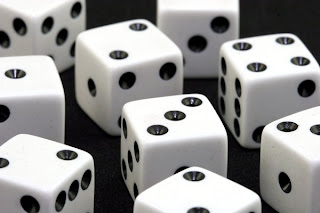
Dice are familiar objects, right? Little cubes that fit in your hand, numbered one through six with decorative dots.

Think about one of them. One die, strange as the singular name seems. Which of its six sides is most important? Which of the six numbers is most important?

Well, it really depends on the game, right? And without the context of some particular game, no side is more nor less important than the others. All six sides are facets of the whole object. Dice wouldn't be dice without all six sides.

People sometimes ask me what I think is the most important aspect of sustainability. What's the most important problem? What's the most urgent? What's the one thing that worries me most?

Like identifying the most important side of a die, the answer varies. My answers to such questions vary from day to day, from conversation to conversation, depending upon the context. But there are some recurring themes.

When I try to explain the recurring themes I sometimes suggest a visual metaphor. So far, the best visual metaphor I've found comes from those six sides of dice.

So here's a list of things I consider crucial to achieve a sustainable culture. Like the sides of dice, these are all facets of a whole. No one of them is necessarily more nor less important than the others. They're all related. I won't number them nor rank them. I just list them in some order that seems convenient and flows, like this...

  • empathy

  • ability to perceive harm
    (even subtle harm)

  • ability to anticipate consequences
    (outcomes both good and bad)

  • maturity
    (regardless of birthdays)

  • healthy engagement with the real universe around us

  • ability to learn
    (especially from mistakes and unexpected outcomes)


Conservation is important. Recycling is important. Economic justice is important. Of course!

But all of those important things result from our human interactions: our human interactions with each other, and our human interactions with the real universe that surrounds us.

Sustainability is about attitude. Sustainability is about culture. Sustainability is about empathy, and maturity, and the ability to perceive harm in all its forms. Sustainability is about anticipating consequences. Sustainability is about anticipating harm. Sustainability is about learning from our mistakes. Sustainability is about seeing the real universe and engaging reality as healthy grown-ups.

Sustainability is about all of those things, and a lot more. But that seems a good start.


---

In his own way, Professor George Mobus addresses many of these sides of the dice at his blog, Question Everything.

Photo courtesy of Designs by Darren.

Wednesday, March 28, 2007

Seeking solutions in the culture domain

A while ago I wrote a brief satirical bit about culture, comparing culture to conspiracy. And the occasional reader who lands here after following my comments at other web sites may notice that I use the word “culture” frequently.

My reason is simple: The concept of culture is a model I find useful.

Since I use the word so often it occurs to me that I should begin to explain how I think about culture and why I find it so useful.

Satirical comparisons aside, one broad working definition of culture I like to use is this:

Culture is what we do,
and the stories we tell about why we do it.


You know the advice, “When in Rome, do as the Romans do”? That's culture. When someone looks at me strangely and asks, “You're not from around here, are you?” That's culture. On the first day at a new job, when someone says, “That's not how we do things around here!” That's culture.

When someone says, “I can't do that because I'm a Somethingist”, that's a culture story. When someone says, “I must do this because I'm a Somethingist”, that's another culture story.

Every day, we humans do things. And we explain to each other why we do those things and why don't do other things. Every day we navigate a sea of deeds, steering by the stories we tell.

(Sometimes we navigate totally on autopilot, by habit, following courses plotted by stories we no longer bother to pay attention to. But that's a story for another day.)

Okay, interesting metaphor, that, but what's it good for?

Well, for one thing, thinking about what we do and the stories we tell to explain ourselves is a different way of seeing. It's a perspective that I rarely see or hear mentioned in the news, in blogs, in conversation. Seeing from the perspective of culture exposes facets of our world that remain hidden when viewed only from the perspective of economics or from the perspective of politics.

But more than that, thinking in terms of culture offers a way to simplify some complex issues. It offers a way to transform thorny, intractable problems with unsatisfying half solutions into simpler, manageable problems with potentially satisfying solutions.

This concept of a transform comes from my background in engineering. Sometimes, for example, a math problem seems incredibly complicated, tedious, and difficult when it's expressed in terms of time. If that problem can be rewritten, if it can be expressed in terms of frequency, it may be easier to analyze and easier to solve. Then when an answer has been found in terms of frequency, that solution can be transformed back, to be expressed in terms of time. The problem and its solution can be transformed back and forth between the “time domain” and the “frequency domain”.

But I'm not interested in math problems anymore. I'm interested in environmental problems. I'm interested in social problems. I'm interested in economic problems. I'm even interested in (eeww!) political problems. And when I spend time with like-minded people who hope to solve those problems, I see some of my colleagues expend enormous energy and time grappling with intractable methods that lead to unsatisfying half solutions (and worse, to new problems).

It seems to me there's an easier way. It seems to me that politics boils down to things that people do and stories we tell each other about why we do those things. The Economy and the businesses that operate within The Economy are just things that people do and stories about why we do them. Crime, poverty, and public education? Things we do. Stories we tell. And the environment? Our home planet is going downhill fast as a consequence of the things people do and the stories we tell each other about why we continue to do them.

That's culture. Deeds and stories.

It seems to me that culture ties together all those other problem domains. Culture is their common denominator, their common variable. That means all those problems can be expressed in terms of culture. Those problems can be transformed into the culture domain. I'm confident there are simpler solutions — in the culture domain.

And after we've found simpler, more satisfying solutions, we can — if we wish — transform those solutions back to the economic domain, back to the political domain, back to the public school domain.

I'm confident our problems can be solved. I'm confident that satisfying solutions can be found — but not in the domains where many folks are currently looking. We've been trying for years and years to solve problems of crime and poverty and pollution in the political domain or the economic domain. How many stories do we tell each other about why we keep trying to do those things?

I'm tired of economic misdeeds and political fairy tales. I'm tired of so-called solutions that create new problems.

For the sake of our children and grandchildren, we need to do things differently. That means we need a better story to make sense of the things we do. That's culture.

And that's why I talk about culture so much. That's why I look at problems from the perspective of the culture domain. That's why I seek solutions within the culture domain. That's why I see culture as a model that's useful.


-------------------------------------------

Something to keep in mind about this model of culture: Most models are wrong, but some are useful.

Culture:  things we do, stories we tell. See The Fifth Discipline, by Peter Senge, for example. Also Moral Politics: How Liberals and Conservatives Think, by George Lakoff, and Ishmael, by Daniel Quinn.

See how this piece fits other pieces at BluePuzzle.org.
 

Friday, February 23, 2007

Tip of the iceberg

The world weighs on my shoulders
But what am I to do?

You sometimes drive me crazy
But I worry about you

I know it makes no difference
To what you're going through

But I see the tip of the iceberg
And I worry about you...


I often think about the metaphor of “the tip of the iceberg”. It's a common phrase, and we all know it suggests there may be something huge, mysterious, and dangerous hidden from our view. But do we use that knowledge effectively? Does it make a difference?
The world weighs on my shoulders...

Over the course of a couple of years I participated in many earnest conversations about the future of humanity and the fate of our planet. I found it amazing, and frustrating, how often conversations among dedicated, like-minded people turned to anger and acrimony.

You sometimes drive me crazy...

After a while I learned to recognize the pattern. I learned to spot the icebergs and to predict their intersecting courses. I tried to warn folks. Like the familiar history of a certain ship, people would wave me off and say, "There's no iceberg out there. Even if there is, it doesn't pose a threat to me."

I know it makes no difference...

Icebergs are big, slow-moving, and ponderous. There's plenty of time to change course, to steer a conversation differently. But there's no iceberg out there. And even if there is, it's not a threat.

But I see the tip of the iceberg...

Crunch.

After a while all those colliding conversations begin to look the same to me. I see frustrated people standing on the tips of icebergs, shouting angrily, throwing snowballs at each other, wondering what happened. And they're far apart. Too far to talk, usually. Below the waterline the hidden parts of icebergs collide long before their tips ever meet.

But what am I to do?

Sometimes people declare, "You can't say this. You can't have that conversation. It just doesn't work." I can see why. But I find greater value in thinking of the situation this way: In what circumstances could we have that conversation? To whom can we say that? When, and where? In what circumstance is it safe to have that conversation?

It seems to me the important first step is to acknowledge the existence of the hidden part of the iceberg. Too often we try to talk about the tips of icebergs without recognizing the submerged assumptions, the accumulated history of feelings and memories below the surface. Even if we don't talk about those things explicitly, if we can at least acknowledge they exist, if we can recognize the rest of the iceberg and adjust to accommodate it, then we might have more satisfying dialog. Then we might have more effective, more productive dialog.

We might invite other people over to our iceberg. Or we might climb down from the tips of our personal icebergs and meet elsewhere. Sometimes we might mean saying, "Sure, we can talk about that, but not here." Or it might mean deciding, "This is better suited to a different audience." Mostly I think it means behaving as if we know the iceberg is there.

I see the tip of the iceberg...

I've seen the tip of the iceberg, and I've learned that acknowledging the rest of it does make a difference to what we're going through.


-------------------------------------------
"I see the tip of the iceberg" quoted from the song, Distant Early Warning, lyrics by Neil Peart, Rush, Grace Under Pressure, 1984.

Photo by Ralph Clevenger, 1999

This is a follow-up to an earlier piece: Of icebergs, NPR, and language

Tuesday, November 21, 2006

To be wise is to see

I'm intrigued by the notion of seeing as a metaphor for learning and for understanding. I'm also concerned about wisdom, how we apply our knowledge, and how we make decisions. So it caught my eye when Canadian blogger Dave Pollard mentioned that the word “wise” originally meant “to see”. The Online Etymology web site reveals

 “to see,” hence “to know”
(see vision)

See vision, indeed. See. Vision. Perspective. Viewpoint. Foresight. 20/20 hindsight. Insight. Take a close look. Take a closer look. Seeing is believing. Blind. Blindness. Blind spot.

Do you see what I see? Do I see what you see? How do we compare and communicate what we see?

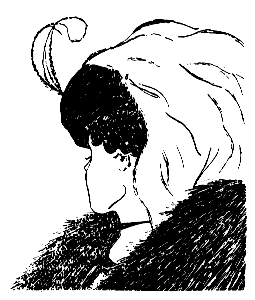
Have you ever been with other people while looking at one of those optical illusions? Have you ever been the one person who couldn't see what everyone else sees? It's frustrating! It's easy to suspect they're just playing a prank.

Or, have you ever tried to help someone to see the other image? That can be frustrating, too. “Well, if you kinda squint your eyes this way and turn your head...now do you see it?”

In a way that experience is the whole point of this blog. It's the point of my other web sites, too. Can I see what you see? Can you see what I see? How do we acknowledge and demonstrate what we see?

It seems to me that our culture often tries to tell us there's only one thing that can be seen. Ever. If we see something else, well, we'd better keep it to ourselves. Our culture tells us, “This is a picture of a vase. It's only a vase. If you think you see something else in this picture, well, you're wrong! Because it's a vase.”

We have 24-hour “news” channels, and magazines and newspapers and radio stations, all to remind us that this is a vase — and only a vase. Vase, vase, vase. Wait! Breaking news! “Some nut claims to see faces in this picture. Har har har, isn't that quaint? Faces! Now back to you, Sue, with the 5-day vase forecast.”

Blindness. Blind spots. Vision. Perspective. Insight.

To see, hence, to know. To be wise is to see.


Saturday, July 08, 2006

Escaping the pinch of the finger trap

Have you ever felt the pinch of a finger trap puzzle?

A finger trap looks harmless. It's just a small tube made of paper. Perhaps a jokester friend handed one to you and said, "Here...stick your fingers in this thing, then pull them out." How hard can that be?

So you play along, stick your fingers into the tube, pull, and find your fingers stuck. Trapped. Pinched.

Also puzzled, and probably frustrated, most of us react by pulling harder. Getting our fingers out must involve pulling, right? So we pull harder. And the finger trap pinches tighter.

The secret of the finger trap is our belief that pulling harder ought to work. But pulling harder doesn't work; that's what makes it a trap. The solution to escape the finger trap is to push gently first. Pushing into the tube releases its pinch. Only then can we carefully remove one finger at a time.

Escaping a finger trap isn't just a matter of pushing, though. It's also a matter of understanding first how the trap works. First we need insight into its mechanism. When we discover our initial belief works badly, that pulling harder pinches tighter, then we adjust our belief to accomodate a method that works.

Or...not.

Reading the news, hearing the news, watching the news, how many of those stories are about pulling harder on traps that are pinching tighter? Why does it seem so difficult to accept that pulling harder pinches tighter? If it didn't work yesterday, and it's not working today, why believe that pulling harder might suddenly work tomorrow?

A finger trap is just a toy, and its mechanism seems simple. So it's no big deal to adjust our belief about how it works.

If we believe that life is hard, that life is complicated, that there are no easy answers, that a lifetime of effort to pull harder must be rewarded, then a simple solution like, "Push gently," can seem disappointing. Judging by the news, apparently we believe that difficult problems deserve difficult solutions.

There are plenty of times when we claim we seek easy answers. When offered simple solutions, however, how often do we reject them by saying, "Well, that can't be right!" ?

The secret to escape a finger trap is to understand it first. Insight into the mechanisms that trap us leads to solutions that actually work. What we believe about the mechanisms of our world make a huge difference in our ability to live freely--or to feel pinched tightly in a giant finger trap.


---


Peter Senge's book, The Fifth Discipline, offers a remarkable source of insight into difficult situations and insight into beliefs that can trap us.

The Sustainability Institute is one organization that applies the same thinking to encourage solutions to global challenges.

To see how this piece fits related pieces please visit BluePuzzle.org.

Tuesday, June 06, 2006

Finding value, not just flaws

I'm pleasantly surprised by the number of readers who find their way here because they seek information about George Box and his comments about conceptual models.

In other words: There are some! I hope those seekers find wisdom and applicability in his comment, as I have.

Most models are wrong, but some are useful. The realization that most mental models, along with policies, plans, propositions, crazy ideas, brilliant ideas, and just plain ideas, the realization that most of them have flaws makes finding their flaws seem pointless. Yeah, they're flawed, but so what? Some are useful. I like the way this insight redirects our attention toward usefulness.

I like that attitude a lot. In my experience that attitude brings knowledge and understanding with minimal hassle and conflict. It contrasts with an attitude that I find disturbingly common. I spend considerable time in the presence of people who delight in finding flaws, but who express no interest in finding utility. Their trademark characteristic, their default attitude, and their habitual behavior is rejection. And way too often, it's vehement, vociferous, angry rejection.

What's up with that?

I feel like I've inadvertantly stumbled into a shooting gallery. So many of these self-proclaimed skeptics seem to do nothing but wait for ideas to be tossed in front of them like clay targets. Bang! Another idea shot down. Did that idea have merit? Who cares! I shot it! I found a flaw! Woohoo!

I used to be a pretty good shot myself, in that way. I practiced daily, just like the idea shooters blasting away now on the web, on TV, on radio. But if most models are wrong, if most ideas are flawed, then we're surrounded by pathetically easy targets. Found a flaw? So what. An attitude and worldview in which most models are wrong, but some are useful, puts shotgun skepticism in a less flattering perspective.

Whether we call it skepticism, cynicism, or critical thinking run amok, by itself it's not helpful. Such behavior is not useful.

Can we find value? Can we find utility? Is this model, this idea, this proposition, is it useful? Surrounded by trigger-happy shooters trying to impress their friends (it's no fun without an audience, is it?) finding value amid the noise and the debris, that's a talent I admire.

Does this beg the question whether I'm finding flaws in finding flaws, whether I'm skeptical of skepticism? Of course it does. Bang. We shot that one, too. And gained nothing of value.

Instead, what if...?

What if we think of finding flaws as just one component of careful, clear thinking? It seems to me that seeking value, seeking merit, seeking usefulness, that attitude of inquiry is another component of careful, clear thinking. To me that's a critical component of critical thinking.

Compare:


Shooting down ideas for the sake of making a big noise and impressing a crowd;

to

Seeking usefulness while acknowledging limitation...

What attitude do we display in each case? What's the most likely outcome in each case?

Which attitude creates the world we want?

Monday, May 08, 2006

Most models are wrong, but some are useful

That's a paraphrase of an observation by George Box. The actual statement by Professor Box is longer and rather convoluted. Its common misquotations are actually more eloquent and rather profound.

I have used the most common phrasing, "All models are wrong, but some are useful", as a signature in my online conversations during the past couple of years.

It occurred to me that the statement itself is a sort of model, and that it should be subject to its own wisdom. An absolute assertion such as "All models" begs for a counterexample, which is exactly the sort of nitpicking that Box tried to discredit. And since it's already a misquote, I think it's within the spirit of the statement to phrase it as:

Most models are wrong, but some are useful.

I've found that statement describes a very, very useful way to think about our world. I use it daily to figure out how to fit together disparate puzzle piece ideas.

Thanks, Professor Box, for contributing such a useful model to our often puzzling world.

Friday, March 10, 2006

This is not about not

Think about the word 'not'.

It's compact and concise. Just three letters, one syllable. It certainly seems simple enough. It negates, it inverts, it turns an idea upside down, or....not?

The word 'not' is another piece that fits very different puzzles. In the realm of formal logic, computer science, rhetoric, and debate, for example, there the word 'not' is a strong, powerful tool. It transforms the meaning of anything and everything in its path. We learn to think--and to speak and to write--in terms such as, "This thing is true. That other thing is not true."

For people who think and speak and write in terms of formal logic, for people who keep a formal logic puzzle in their minds, the word 'not' is a puzzle piece that transforms every piece attached to it. It transforms the puzzle itself.

But for other readers and listeners who may have other picture puzzles in mind, the word 'not' can be surprisingly weak and unhelpful at times. Like a hamster harnessed to a boxcar, the hamster may be too weak to pull the boxcar and too small even to be noticed standing next to it. Those pieces may be assembled as a picture puzzle labeled "hamster pulling boxcar", but many folks will see only the boxcar.

Consider this:

This sentence is not about a boxcar. It is not related to boxcars in any way. Believe me when I tell you, "This paragraph is not about boxcars." Really! I insist! Boxcars are not relevant here! What in the world would make you think any of this could possibly involve boxcars?

So....what is that paragraph about? Formal logic requires that we look for an invisible hamster. An ardent mathemetician who practices formal logic could say that paragraph is about everything in the universe except boxcars, including hamsters (both visible and invisible), as well as aardvarks, baseball, cream cheese, dust mites, and every alphabetized noun through Zen monk. Just remember, no boxcars allowed.

How often does that method actually work? Two mathematicians who share a frame of reference involving formal logic might communicate that way. Computer scientists might communicate that way, and even understand each other. Debate teams could launch any argument from that "not boxcar" frame. But most of the time, with an anonymous audience of unknown background, does that paragraph depict a picture of anything other than a boxcar?

Not likely. Try it sometime. Actually, if we think about it, many of us have tried it already, and many of us have been puzzled by our difficulty conveying our meaning that way. Neither emaphasis nor insistence add clarity. Repetition makes the situation worse. The darn boxcars just get BIGGER in the reader or listener's mind.

With any frame of mind other than formal logic, that paragraph was about boxcars. Sprinkling the tiny one-syllable 'not' throughout has little effect. If that paragraph was not about boxcars, then it was about nothing at all.

How many times have you heard or read comments like these: "Please don't take this personally, but..." or "I'm not here to shoot down your idea, but..."

Ouch! If someone shoots down my idea that way, I suspect I will take it personally. After all, I was practically commanded to do so. Those supposedly soothing prefaces actually put me on edge, on guard, expecting the worst. Rather than ease my likely reaction, they set me up to react with extra vehemence. My mind doesn't react to the little hamster words, it reacts to the big boxcar concepts. How about you?

In the future, let's not rely on the word 'not'. Oops! ummmmm.....

In the future, let's just focus on the boxcar.


Cheers

p.s. I am not a blogger.

Thursday, March 09, 2006

Imagine a picture puzzle

It comes in a medium-sized box full of hundreds of intricate little pieces. When assembled it will depict a landscape, perhaps, with large swatches of blue sea and blue sky.

Imagine my mind is like one of those picture puzzles, and so is yours. I take one of those blue puzzle pieces, give it to you, and declare, "Here's a bit of the picture in my mind. I give it to you so you can see the picture I see." I take that piece from the sky portion of my mind's picture puzzle, but you find it fits best in the sea portion of yours. "Thanks!" you say, as you join my sky piece to your sea puzzle. And off we go, cheerfully believing we have accomplished something, that we have communicated.

George Bernard Shaw wrote, "The single biggest problem in communication is the illusion that it has taken place."

Sometimes I think of it as the illusion of information. If I hand you a blue puzzle piece from the picture in my mind, but I don't describe the surrounding picture from which it came, I set up both of us to misunderstand each other, to miscommunicate, to see only an illusion of information.

This blog offers a collection of puzzle pieces. These are the pieces I find most helpful to create a coherent picture of the world around us.

Of course, if I really want to communicate effectively, I need to describe the whole puzzle, don't I?

More pieces to follow...