Tip of the iceberg
The world weighs on my shoulders
But what am I to do?
You sometimes drive me crazy
But I worry about you
I know it makes no difference
To what you're going through
But I see the tip of the iceberg
And I worry about you...
 I often think about the metaphor of “the tip of the iceberg”. It's a common phrase, and we all know it suggests there may be something huge, mysterious, and dangerous hidden from our view. But do we use that knowledge effectively? Does it make a difference?
The world weighs on my shoulders...
Over the course of a couple of years I participated in many earnest conversations about the future of humanity and the fate of our planet. I found it amazing, and frustrating, how often conversations among dedicated, like-minded people turned to anger and acrimony.
You sometimes drive me crazy...
After a while I learned to recognize the pattern. I learned to spot the icebergs and to predict their intersecting courses. I tried to warn folks. Like the familiar history of a certain ship, people would wave me off and say, "There's no iceberg out there. Even if there is, it doesn't pose a threat to me."
I know it makes no difference...
Icebergs are big, slow-moving, and ponderous. There's plenty of time to change course, to steer a conversation differently. But there's no iceberg out there. And even if there is, it's not a threat.
But I see the tip of the iceberg...
Crunch.
After a while all those colliding conversations begin to look the same to me. I see frustrated people standing on the tips of icebergs, shouting angrily, throwing snowballs at each other, wondering what happened. And they're far apart. Too far to talk, usually. Below the waterline the hidden parts of icebergs collide long before their tips ever meet.
But what am I to do?
Sometimes people declare, "You can't say this. You can't have that conversation. It just doesn't work." I can see why. But I find greater value in thinking of the situation this way: In what circumstances could we have that conversation? To whom can we say that? When, and where? In what circumstance is it safe to have that conversation?
It seems to me the important first step is to acknowledge the existence of the hidden part of the iceberg. Too often we try to talk about the tips of icebergs without recognizing the submerged assumptions, the accumulated history of feelings and memories below the surface. Even if we don't talk about those things explicitly, if we can at least acknowledge they exist, if we can recognize the rest of the iceberg and adjust to accommodate it, then we might have more satisfying dialog. Then we might have more effective, more productive dialog.
We might invite other people over to our iceberg. Or we might climb down from the tips of our personal icebergs and meet elsewhere. Sometimes we might mean saying, "Sure, we can talk about that, but not here." Or it might mean deciding, "This is better suited to a different audience." Mostly I think it means behaving as if we know the iceberg is there.
I see the tip of the iceberg...
I've seen the tip of the iceberg, and I've learned that acknowledging the rest of it does make a difference to what we're going through.
-------------------------------------------
"I see the tip of the iceberg" quoted from the song, Distant Early Warning, lyrics by Neil Peart, Rush, Grace Under Pressure, 1984.
Photo by Ralph Clevenger, 1999
This is a follow-up to an earlier piece: Of icebergs, NPR, and language

 I've been planning to recommend Ursula K. Le Guin's delightful book,
 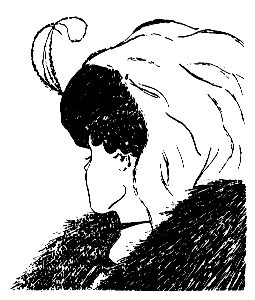 Have you ever been with other people while looking at one of those optical illusions? Have you ever been the one person who couldn't see what everyone else sees? It's frustrating! It's easy to suspect they're just playing a prank.
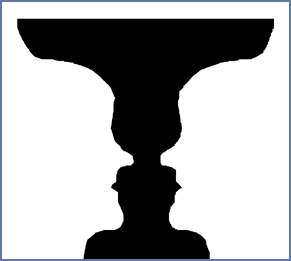 It seems to me that our culture often tries to tell us there's only one thing that can be seen. Ever. If we see something else, well, we'd better keep it to ourselves. Our culture tells us, “This is a picture of a vase. It's only a vase. If you think you see something else in this picture, well, you're wrong! Because it's a vase.”
 As I mentioned earlier, the theme of this 77th week of the Tar Heel Tavern is "the future". I like to have a theme when I host the Tavern here. It helps me to frame the pieces that I receive within the context of my blog. I realized as I looked over this weeks' contributions that the future is really about connections between the past, the present, tomorrow, and generations to come. It seems to me we construct narratives, stories, to make sense of those connections.
  Meanwhile Mr. Ogre searched for a view into the future. He was astonished to discover his own past, especially when it turned out to be a past view of his future. Or maybe our popular mechanical future. Or a future past. But it's really none of those things. Confused?