Sunday, April 22, 2007

Google's Earth Day logo

melting iceberg spells Google

When we begin to live in sustainable ways, every day will be Earth Day.

Until then, designating at least one day to focus attention on the state of our planet, to focus attention on the state of our home, that's a good deed. I commend the many people and organizations who make Earth Day notable, including Google.

As serious and as urgent as global warming is, it's the tip of the iceberg of sustainability. Let's spend some time over the next 364 days to explore the rest of the iceberg, shall we?

How will we live when we discover that it's not the ends, but the beginnings that justify our means?

Thanks for your time and attention


Sunday, April 15, 2007

Thanks. It's nice to be noticed.

Karmen, who blogs at Chaotic Utopia, kindly designated me a Thinking Blogger. Thanks, Karmen, it's nice to be noticed.

Like the ten books meme, this blog meme offers an opportunity to share what we care about. Following the Thinking Blogger links forward and backward can be an interesting way to catch a glimpse of things other writers care about.

The Thinking Blogger Award is a “name five” meme. My task is to share what I care about by naming five more Thinking Bloggers. Very well, then — in no particular order, here are five more bloggers in this meme's path:

Chris Hardie - Along with his personal blog, Chris has created a podcast site to explore news local to his town. How many of us have been compared to a one-man version of National Public Radio?

Christine Kane - An Asheville-based musician when she's not blogging, Christine often writes about themes that overlap mine, but she writes from a somewhat different point of view, with a different vocabulary, for a different audience.

Sally Greene - Chapel Hill is the sort of place where a woman who writes a thoughtful blog about literature, architecture, urban planning, and the environment can be elected to local government.

World's Fair - co-written by two guys who teach at two universities on two coasts* of two countries, World's Fair has “all manner of human creativity on display”. I'm pleased to see their creativity sometimes demonstrates systems thinking about sustainability issues.

Stoplight Haiku - Sometimes thoughts have exactly 17 syllables. Sometimes they don't. Either way, they're haiku thoughts.

Thinking Blogger Award graphic

*Okay, so one of the universities is somewhat inland. It's coastal when compared to, say, Nebraska. And it makes the sentence's parallel structure work.

I notice the meme originated with the suggested name “5 Blogs That Make Me Think”. Two months later it seems better known as the Thinking Blogger Award. Memes often spread via inexact copying.


Friday, April 06, 2007

Vine Deloria, Jr., a career summary and a play in one act

Recently I began reading some books by native American Indian author Vine Deloria, Jr. So far I enjoy his unorthodox approach and his playful, witty, and provocative style. I find value in his apparent role as trickster. I think I see what he wanted his readers to see.

Not everyone appreciates the role of trickster as teacher, however, especially outside of native cultures. As I do some more research about the man I notice that some of the folks who criticize him seem mostly baffled by his unconventional perspective. It occurred to me that Vine Deloria, Jr.'s career might be summarized in a very brief one act play...

Vine Deloria, Jr.: I reject the rules of white culture.

Critics: Goshdarnit, Deloria! You're not playing by our rules!

Vine Deloria, Jr.: No kidding.


Since I have previously declared that I don't do book reviews, this certainly should not be construed as one. I'm just noting another instance of personal perspective on culture, another illustration of faces and vases, of icebergs and the illusion of communication.

Yup, that's all, really.

Wednesday, March 28, 2007

Seeking solutions in the culture domain

A while ago I wrote a brief satirical bit about culture, comparing culture to conspiracy. And the occasional reader who lands here after following my comments at other web sites may notice that I use the word “culture” frequently.

My reason is simple: The concept of culture is a model I find useful.

Since I use the word so often it occurs to me that I should begin to explain how I think about culture and why I find it so useful.

Satirical comparisons aside, one broad working definition of culture I like to use is this:

Culture is what we do,
and the stories we tell about why we do it.


You know the advice, “When in Rome, do as the Romans do”? That's culture. When someone looks at me strangely and asks, “You're not from around here, are you?” That's culture. On the first day at a new job, when someone says, “That's not how we do things around here!” That's culture.

When someone says, “I can't do that because I'm a Somethingist”, that's a culture story. When someone says, “I must do this because I'm a Somethingist”, that's another culture story.

Every day, we humans do things. And we explain to each other why we do those things and why don't do other things. Every day we navigate a sea of deeds, steering by the stories we tell.

(Sometimes we navigate totally on autopilot, by habit, following courses plotted by stories we no longer bother to pay attention to. But that's a story for another day.)

Okay, interesting metaphor, that, but what's it good for?

Well, for one thing, thinking about what we do and the stories we tell to explain ourselves is a different way of seeing. It's a perspective that I rarely see or hear mentioned in the news, in blogs, in conversation. Seeing from the perspective of culture exposes facets of our world that remain hidden when viewed only from the perspective of economics or from the perspective of politics.

But more than that, thinking in terms of culture offers a way to simplify some complex issues. It offers a way to transform thorny, intractable problems with unsatisfying half solutions into simpler, manageable problems with potentially satisfying solutions.

This concept of a transform comes from my background in engineering. Sometimes, for example, a math problem seems incredibly complicated, tedious, and difficult when it's expressed in terms of time. If that problem can be rewritten, if it can be expressed in terms of frequency, it may be easier to analyze and easier to solve. Then when an answer has been found in terms of frequency, that solution can be transformed back, to be expressed in terms of time. The problem and its solution can be transformed back and forth between the “time domain” and the “frequency domain”.

But I'm not interested in math problems anymore. I'm interested in environmental problems. I'm interested in social problems. I'm interested in economic problems. I'm even interested in (eeww!) political problems. And when I spend time with like-minded people who hope to solve those problems, I see some of my colleagues expend enormous energy and time grappling with intractable methods that lead to unsatisfying half solutions (and worse, to new problems).

It seems to me there's an easier way. It seems to me that politics boils down to things that people do and stories we tell each other about why we do those things. The Economy and the businesses that operate within The Economy are just things that people do and stories about why we do them. Crime, poverty, and public education? Things we do. Stories we tell. And the environment? Our home planet is going downhill fast as a consequence of the things people do and the stories we tell each other about why we continue to do them.

That's culture. Deeds and stories.

It seems to me that culture ties together all those other problem domains. Culture is their common denominator, their common variable. That means all those problems can be expressed in terms of culture. Those problems can be transformed into the culture domain. I'm confident there are simpler solutions — in the culture domain.

And after we've found simpler, more satisfying solutions, we can — if we wish — transform those solutions back to the economic domain, back to the political domain, back to the public school domain.

I'm confident our problems can be solved. I'm confident that satisfying solutions can be found — but not in the domains where many folks are currently looking. We've been trying for years and years to solve problems of crime and poverty and pollution in the political domain or the economic domain. How many stories do we tell each other about why we keep trying to do those things?

I'm tired of economic misdeeds and political fairy tales. I'm tired of so-called solutions that create new problems.

For the sake of our children and grandchildren, we need to do things differently. That means we need a better story to make sense of the things we do. That's culture.

And that's why I talk about culture so much. That's why I look at problems from the perspective of the culture domain. That's why I seek solutions within the culture domain. That's why I see culture as a model that's useful.


-------------------------------------------

Something to keep in mind about this model of culture: Most models are wrong, but some are useful.

Culture:  things we do, stories we tell. See The Fifth Discipline, by Peter Senge, for example. Also Moral Politics: How Liberals and Conservatives Think, by George Lakoff, and Ishmael, by Daniel Quinn.

See how this piece fits other pieces at BluePuzzle.org.

 

Friday, March 16, 2007

Denying people the right to their own experiences

I see faces in this picture.

No, you don't.

Huh?

I repeat, you do not see faces in that picture.

Well, I understand that you may not see faces, but

No! I mean, you! You. Do. Not. See. Faces.

Oh. Well, um, I'm kind of taken aback by that. I'm pretty sure my own personal experience seems real and legitimate to me. And I'm not saying that you have to experience it exactly the same way, too. I'm just trying to share a description of something I see.

So what? I don't care. I see vase. So you see vase.

Ummmm ... well, that doesn't work for me.

Doesn't matter. I don't care. It's a vase.


Friday, February 23, 2007

Tip of the iceberg

The world weighs on my shoulders
But what am I to do?

You sometimes drive me crazy
But I worry about you

I know it makes no difference
To what you're going through

But I see the tip of the iceberg
And I worry about you...


I often think about the metaphor of “the tip of the iceberg”. It's a common phrase, and we all know it suggests there may be something huge, mysterious, and dangerous hidden from our view. But do we use that knowledge effectively? Does it make a difference?

The world weighs on my shoulders...

Over the course of a couple of years I participated in many earnest conversations about the future of humanity and the fate of our planet. I found it amazing, and frustrating, how often conversations among dedicated, like-minded people turned to anger and acrimony.

You sometimes drive me crazy...

After a while I learned to recognize the pattern. I learned to spot the icebergs and to predict their intersecting courses. I tried to warn folks. Like the familiar history of a certain ship, people would wave me off and say, "There's no iceberg out there. Even if there is, it doesn't pose a threat to me."

I know it makes no difference...

Icebergs are big, slow-moving, and ponderous. There's plenty of time to change course, to steer a conversation differently. But there's no iceberg out there. And even if there is, it's not a threat.

But I see the tip of the iceberg...

Crunch.

After a while all those colliding conversations begin to look the same to me. I see frustrated people standing on the tips of icebergs, shouting angrily, throwing snowballs at each other, wondering what happened. And they're far apart. Too far to talk, usually. Below the waterline the hidden parts of icebergs collide long before their tips ever meet.

But what am I to do?

Sometimes people declare, "You can't say this. You can't have that conversation. It just doesn't work." I can see why. But I find greater value in thinking of the situation this way: In what circumstances could we have that conversation? To whom can we say that? When, and where? In what circumstance is it safe to have that conversation?

It seems to me the important first step is to acknowledge the existence of the hidden part of the iceberg. Too often we try to talk about the tips of icebergs without recognizing the submerged assumptions, the accumulated history of feelings and memories below the surface. Even if we don't talk about those things explicitly, if we can at least acknowledge they exist, if we can recognize the rest of the iceberg and adjust to accommodate it, then we might have more satisfying dialog. Then we might have more effective, more productive dialog.

We might invite other people over to our iceberg. Or we might climb down from the tips of our personal icebergs and meet elsewhere. Sometimes we might mean saying, "Sure, we can talk about that, but not here." Or it might mean deciding, "This is better suited to a different audience." Mostly I think it means behaving as if we know the iceberg is there.

I see the tip of the iceberg...

I've seen the tip of the iceberg, and I've learned that acknowledging the rest of it does make a difference to what we're going through.


-------------------------------------------
"I see the tip of the iceberg" quoted from the song, Distant Early Warning, lyrics by Neil Peart, Rush, Grace Under Pressure, 1984.

Photo by Ralph Clevenger, 1999

This is a follow-up to an earlier piece: Of icebergs, NPR, and language

Tuesday, February 13, 2007

Two worth reading

We shall not cease from exploration
And the end of all our exploring
Will be to arrive where we started
And know the place for the first time.


Changing Planes cover I've been planning to recommend Ursula K. Le Guin's delightful book, Changing Planes, since I discovered it a few weeks ago. The reward for procrastination is an opportunity to pair it with Jose Saramago's unusual book, The Cave.
Changing Planes presents itself as a sly travelogue, a collection of short stories that describe some of the planes of existence a traveler can reach after experiencing the peculiar combination of stress, boredom, and indigestion that occurs only in a modern airport.

The book's back cover blurb observes that Le Guin's stories of exotic places and peoples all reflect the here and now of 21st century life. Most notable for me were the perpetually annoyed and squabbling people of Veks, the reckless genetic experiments on Islac, the thoughtful people of Ansarac who took some bad advice but abandoned it for their own time-tested wisdom, and the sad holiday island of Great Joy.

While searching Le Guin's web site for supplementary links I noticed her recommendation of Nobel prize-winner Jose Saramago's books, Seeing, Blindness, and The Cave. The titles Seeing and Blindness caught my eye because I've written a bit myself about seeing and not seeing. Saramago's writing style may challenge us, but readers who appreciate William Faulkner's page-long streams of consciousness should be equally comfortable with Saramago's technique. What Saramago's charming characters discover deep within The Cave is both disturbing and liberating:

They are us!


----------------------------------------------------------

The Cave and other books by Jose Saramago are available from Powell's and from local bookstores

Ursula K. Le Guin's web site is worth exploring

“We shall not cease from exploration...”
quoted from Four Quartets, by T.S. Eliot


Sunday, January 21, 2007

Internet mud wrestling

As we careen headlong into a future that's globalized, industrialized, and urbanized, I suspect we lose our connection to our rural roots. Barely a generation removed from the farm, we're already losing the context that informed the common sense our grandparents shared.

I hope we've retained some of their common sense, enough to appreciate the insights expressed in some of our grandparents' sayings. Almost daily, on the Internet and on TV, I witness reminders of this one:


Never wrestle a pig in mud.
You both get dirty --
but the pig enjoys it.


The pig enjoys it.


Tuesday, January 16, 2007

Seeking, finding ... seeing

To paraphrase ... some guys ... we can't always find what we want. But if we try, we just might find what we need.

To be wise is to see...


Thursday, January 11, 2007

No more burned marshmallows

My parents often took me camping when I was a young child. At night we sat around the campfire, and sometimes we roasted marshmallows. Well, my parents roasted their marshmallows. I burned mine.

I hadn't yet learned patience. I was too eager to get to the toasty marshmallow result to spend much time holding the marshmallow away from the flames. Clearly they toasted faster if they were held closer to the flames. Or right in the flames. Then they caught fire, burned, and charred.

Each time that happened, I blew out the flames around the blackened sugar lump, waited as long as I could stand for it to cool, and then ate it. Sometimes I tried to remove the charred black crust, but that rarely worked. So I ate burned, black, slightly-sweetened charcoal.

Mmmm ... charcoal.

I assured my mom and dad, and my friends when they camped with us, that "I really like burned marshmallows! I enjoy eating them that way."

To prove it, I quit trying to toast them carefully. I deliberately held every fresh marshmallow right in middle of the flames. I became skilled at burning them. I declared they were even tastier when they caught fire twice. Three times even.

"Mmmm ... I really like burned marshmallows!"

But I didn't, of course. Burned marshmallows taste bad. They taste like burned ... well, they taste like burned anything. They taste burned.

Eventually I tired of pretending to enjoy burned marshmallows. I decided that learning to be more patient might taste better than pretending to enjoy the flavor of charcoal.

Now, as an adult, sometimes I see people work very hard to pretend that unpleasant outcomes are really going just fine. Often I hear people tell me things that sound remarkably similar to my childish proclamation, "I really like burned marshmallows!"

I don't believe them.


Monday, December 18, 2006

Culture as conspiracy theory

"Oh, you and your conspiracy theories!"

Yeah, well, I tell ya what...

When a small group of people try to fool a bigger group, I call it conspiracy.

When a small group of people try to fool themselves, I call it denial.

When we all try to fool each other, I call it culture.

Wednesday, December 13, 2006

Arithmetic allegory
(3+1=4=1+3)

Did you just say, "3 + 1 = 4?"

Yes, I

That's all wrong! 4 = 1 + 3 !

No, it's 3+1.

1+3!

3+1!


It seems to me there's something they do not see.

Thursday, November 30, 2006

Haiku tunnel (carpal)

The typing finger
with carpal tunnel treatment
having writ, moves on

Tuesday, November 21, 2006

To be wise is to see

I'm intrigued by the notion of seeing as a metaphor for learning and for understanding. I'm also concerned about wisdom, how we apply our knowledge, and how we make decisions. So it caught my eye when Canadian blogger Dave Pollard mentioned that the word “wise” originally meant “to see”. The Online Etymology web site reveals

 “to see,” hence “to know”
(see vision)

See vision, indeed. See. Vision. Perspective. Viewpoint. Foresight. 20/20 hindsight. Insight. Take a close look. Take a closer look. Seeing is believing. Blind. Blindness. Blind spot.

Do you see what I see? Do I see what you see? How do we compare and communicate what we see?

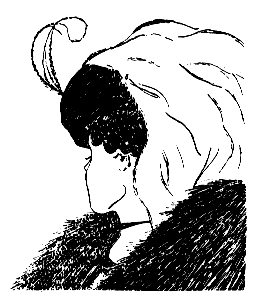
Have you ever been with other people while looking at one of those optical illusions? Have you ever been the one person who couldn't see what everyone else sees? It's frustrating! It's easy to suspect they're just playing a prank.

Or, have you ever tried to help someone to see the other image? That can be frustrating, too. “Well, if you kinda squint your eyes this way and turn your head...now do you see it?”

In a way that experience is the whole point of this blog. It's the point of my other web sites, too. Can I see what you see? Can you see what I see? How do we acknowledge and demonstrate what we see?

It seems to me that our culture often tries to tell us there's only one thing that can be seen. Ever. If we see something else, well, we'd better keep it to ourselves. Our culture tells us, “This is a picture of a vase. It's only a vase. If you think you see something else in this picture, well, you're wrong! Because it's a vase.”

We have 24-hour “news” channels, and magazines and newspapers and radio stations, all to remind us that this is a vase — and only a vase. Vase, vase, vase. Wait! Breaking news! “Some nut claims to see faces in this picture. Har har har, isn't that quaint? Faces! Now back to you, Sue, with the 5-day vase forecast.”

Blindness. Blind spots. Vision. Perspective. Insight.

To see, hence, to know. To be wise is to see.


A startlingly different view of the world

“He was constantly reminded of how startlingly different a place the world was when viewed from a point only three feet to the left.”

That's from The Salmon of Doubt, the book Douglas Adams was writing when he died.

Imagine: A startlingly different place, and only three feet to the left. It seems to me that three steps to the left is an easy journey to see a startlingly different world. That's worth the trip, don't you think?


Tuesday, November 07, 2006

Sides of a coin

“Oh, they're just two sides of the same coin.”

Yeah, well, have you ever looked at a coin?

The sides are different.


Today is a good day to vote.


Thursday, October 26, 2006

Some kinds of people

There are three kinds of people in the world: those who can do math, and those who can't.

No? How about this:

There are 10 kinds of people in the world: those who can do binary math, and the other 01.

Hmmm...

There are two kinds of people in the world: those who don't believe in categorizing others, and ...

Doh!

----------

More at DavidBerreby.com ...


Thursday, October 19, 2006

I don't do book reviews

Books. I like 'em. I read a lot of them.

Often I recommend them to others. (Perhaps you noticed?)

Unfortunately I suspect my recommendations might be more effective if I could muster the willpower to write detailed, enthusiastic reviews. As much as I enjoy books, and as much I want others to appreciate the good ones, I greatly dislike writing book reviews. They remind me too much of book reports and school homework assignments.

Reading a book is fun. Writing about it takes time away from reading the next one.

As a kid in fourth grade I went on strike over book reports. I refused to write them. Specifically, I declined to participate in a classroom contest to try to write more book reports than the other kids. It seemed pretty clear to me that the contest was designed to get some (many?) of the kids to read more. The prospect of gold stars and smiley stickers on a wall chart (or the prize, whatever it was) didn't offer much incentive to me. I already averaged about four books checked out of the library at a time.

My civil disobedience prompted an emergency parent-teacher conference. Although I didn't exactly prevail, we did negotiate a concession: I agreed to stop setting an example of disobedience in exchange for the teacher's acknowledgement that the contest wasn't likely to advance my education.*

Now I have better incentive to write book reports reviews. I want other people to benefit from useful books as much I have. I want other people to read those books. But book reviews still feel like homework to me, and writing them does take time away from reading them.

Unfortunately the statement, “You should read this book because I say so”, doesn't seem to work very well.

I often think of books as tool boxes filled with idea tools. I have some background in engineering so that feels like a natural and obvious approach. For me, recommending a particular book is like recommending a particular tool for a particular task.

“Hi, there. I see you're pounding that nail with a brick. How's that workin' for ya? Have you considered a hammer instead? I just happen to have a hammer right here.”


Most models are wrong, but some are useful
. Good books are full of ideas. Some of them are wrong, but some of them are useful. There are many I might recommend to a particular person in a particular situation. There are a few I recommend widely because they're especially versatile. These are my Swiss Army, Leatherman, toolbox-in-paperback, recommended books:


Each of those three is really a subset of the author's ideas. Each author has body of related work — more toolboxes filled with more tools — but those three are immediately useful.

I know I should say more, of course. But I'd rather be reading.


---

* I give my 4th grade teacher, the late Mrs. Harder, a lot of credit for her unusually candid admission.

More book recommendations with inadequate reviews...


Sunday, October 08, 2006

Tarheel Tavern #85,
setting an example

Welcome to this 85th example of the Tarheel Tavern. Our theme this week is setting an example. My friend and sustainability advocate, Chris, recently posted about the ways he demonstrates sustainable living. Like a blog meme, his example inspired me to think about the ways I try to demonstrate sustainable attitudes. It also reminded me of the theme of ...Slowly she turned, a regular Tavern participant who is slowly turning toward a new blog host.

I remember commenting earlier this summer that part of the value of her community gardening effort is to set an example. When I experienced one of those light-bulb-over-the-head moments three years ago I realized my best contribution would be to persuade other people to see value in sustainable living. The value of mowing my lawn with an electric mower is for my neighbors to see me doing it. The value of bringing my own reusable bags to the grocery store is for other shoppers to see me doing it. I'm very conscious that the value of this blog and my other Internet projects is for readers to see ordinary, real-life examples.

Mr. R., blogging at Evolgen, understands the value of teaching by example. He's also aware of the challenge of setting a good example consistently. As a science teacher he tries to inspire his students, but even the most dedicated science teacher can find it difficult to muster enthusiasm for nine straight weeks of nothing but dihydrogen oxide.

Writing Iddybud's Journal from the northern annex of Tarheel territory, Jude reflects on the challenge her mother faced and the influence of her mother's example. And she finds the sacred within the ordinary.

Mandie, approaching motherhood herself, sets an example of frenzied activity that makes me tired just to summarize it. Have you ever watched one of those home remodeling shows that recap a whole weekend of work in 30 seconds of frenzied sped-up video? Well, Mandie set that pace without the benefit of video effects. Picture a pregnant woman rebuilding multiple home appliances, cleaning gutters, jump-starting cars, constructing a corral, and taking crash courses in fire safety and plumbing 101, while eating chocolate and talking on the phone.

If that makes you tired, you might catch your breath while watching telenovelas en español at Pratie Place. Melinama describes a lifetime of bad behavior by the character of Doña Jacinta. (Viewing hint: "You know she's bad because she dresses in black and carries a cane.") Although the bad guy gal goes down in flames, some viewers wonder if Jacinta escaped too easily.

Real-life TV photographer (but not real name), Colonel Corn describes an interview with a rock star who sets an example by helping real life victims of abusive relationships.

A huge toxic waste fire in central North Carolina became a scary part of our real life this week. At Sustainability Southeast (another project in which I'm involved) we consider the example this sets: the example of our investment in our health and investment in our quality of life.

Over in western North Carolina, the Scrutiny Hooligans observe that a politician sets an example of “do as he says, not as he does”.

At the national level, the political example gets worse. A political operation that trumpeted its particular concept of moral standards recently discovered it doesn't live up to its own example. Ron takes issue with the search for scapegoats as he examines the Foley Fallout.

Thanks, everyone, for sharing your examples. Thanks for sharing what you care about.

Share what you care about.

That was the answer that energy and sustainability problem-solver Hunter Lovins offered when asked the challenging question, "What can I do?" She didn't hesitate before she replied, "Share what you care about."

That's the value of teaching, the value of parenting, the value of community gardening, and the value of blogging.

Thanks for sharing, and thanks for reading.


Tuesday, October 03, 2006

Blame the squirrels

I know a guy who just bought a new car. He believes it's powered by squirrels. Just like in the cartoons. He believes there are squirrels under the hood that make his car go when they run frantically inside those exercise wheels meant for small pets. Every morning before he leaves for work he tosses a handful of nuts in the glove box to keep the squirrels running.

That fantasy ran out of gas, of course.

But he still believes. “Damn lazy squirrels!” he curses, pounding the hood.

“Damn lazy squirrels!”