Wednesday, January 23, 2008

Ideas, wrapped in behaviors

(Some thoughts under development ... )

Ideas, when they form and float through our minds, are just ideas.

Expressing ideas, the act of communicating, is behavior.

We like to believe that our writing, our speaking, our conversations, we like to believe we deal only with ideas. But to me that seems incomplete. It seems to me we often react to the behaviors that we perceive as much or even more than the ideas wrapped in those behaviors.

Words matter
. Words matter because words create consequences. Communicating with words is a behavior.

And behaviors create consequences.


See also:
Show me, don't tell me
and
A sustainable culture begins with a healthy, sustainable attitude


Saturday, January 19, 2008

Amusing Ourselves to Death

I've mentioned this book several times recently in comments elsewhere. It occurred to me that I should mention it at my own web site, too:

Amusing Ourselves to Death: Public Discourse in the Age of Show Business
by Neil Postman

If TV news and talk radio leave you feeling something other than well-informed, Postman's little book might explain why.

Thursday, January 10, 2008

web log, with explosions and funny hats

Occasionally I'm reminded that the concept, "blog", came from "web log", a log of interesting web sites. Pointing out other people's worthy efforts can be one way to support them. Here are two worthy efforts that I support by pointing and clicking:

Trinifar writes clear and concise, yet detailed, essays about sustainability concepts. Trinifar's writing path takes up where mine leaves off. The essay title, “Learning to think about the future”, would have made a good subtitle for my site. (Darn, too late, I guess.)

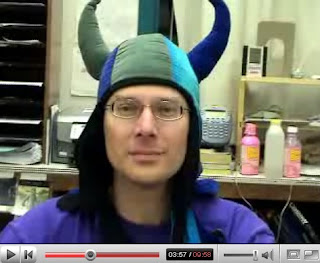
“Learning to think about the future” would also be a good subtitle for this video about climate change. The science teacher who began this YouTube effort a few months ago has refined his message. He sets an excellent example of clear and careful thinking about a challenging topic. He delivers an urgent and serious message, punctuated with explosions and funny hats.

science teacher explains global warming while wearing a funny hat

(click to open this video in a new window or tab)
“While we debate ...
we're running the experiment ...
and we're in the test tube.”


As far as thinking about future posts at this blog, here are a couple of topics that have rattled around inside my head recently:

soap and water; and
What does it mean to “just” get along?


Sunday, October 28, 2007

Circle of observers (rough draft)

Picture a group of people, a dozen or more, standing in a circle, looking outward. They stand shoulder to shoulder, backs to the center, facing away from each other.

Many of them have telescopes, some have binoculars. They all have clipboards and notebooks and lots of pens and pencils in the pockets of their white coats.

They look outward at the universe and declare proudly, "From here we can see everything!"

To the folks outside the circle, however, that comment seems kind of odd. From outside the circle it's easy to see something that's hidden from the proud observers.

From outside the circle, we can see inside the circle. We can observe the observers. We can see their blind spot.

To be wise is to see ... more. To be wise is to see ... that something is missing. To be wise is to see ... that there's probably more to see.

Within the circle of observers, to be wise is to turn around.


Thursday, October 25, 2007

Are we ready yet?

Some things only become visible when we become ready to see them.


Water. Weather. War.

Why?

What are we ready to see?

Is that an iceberg ahead?

Thursday, September 06, 2007

What's the worst that could happen? (a video)

Here's an example of someone who uses water to put out a fire:


(video will open in a new window or tab)

This is an excellent illustration of a way to make a wise, prudent decision when the stakes are high and the consequences are severe.


Saturday, September 01, 2007

How do you put out a fire?

I've noticed some people like to advocate "fighting fire with fire". Their contribution to conversation is to declare, with absolute confidence,

Ya gotta fight fire with fire!

Thing is, most firefighters I know use water.


Tuesday, August 28, 2007

Two questions

Lately I've been watching multiple debates, arguments, shouting matches, and iceberg-tip snowball fights as they sprawl across various blogs. The topics that triggered these noisy brawls vary somewhat, but the pattern of escalation of all the conflicts looks the same to me.

Although it shouldn't surprise me anymore, I confess I still find it remarkable how much effort some people can expend in trying to justify rude and counterproductive behaviors.

I've been trying to find a concise way to describe what I see below the surface of these icebergs. Today it occurred to me that two simple questions could reveal a lot — if anyone cared to ask them:

What are the effects of my own behavior?

How should I behave if I care about the answer?


Sunday, August 19, 2007

The Rule of 150, minus three

About ten years ago I began working with a small tiny Internet company. Did you notice that I say "with" -- not "for"? I was an employee, not a temp, not a consultant, but we were a small group and we worked with each other.

When I began I was the eighth person in the group. They began as five, tightly knit as the saying goes, working closely with each other to manage and sell bandwidth on a small fiber optic network. Changes in the telecommunication industry and the emerging Internet phenomenon steered the little company toward a path of sudden growth.

At the beginning it was a perfect fit for me. They were doing, or were about to do, exactly what I wanted for my career. It was exciting. It was perfect. It was fun. We didn't worry much about job titles or job descriptions or hierarchy. We did what needed to be done, and we had fun doing it. One day I was chatting with one of our Vice President of Sales, and I told him:

"Some days I feel like the janitor. But some days I feel like a Vice President."

"Me, too!" he said. "Me, too."

But the fun didn't last. We bought into the idea that bigger is always better, so we tried to get bigger. We tried to get bigger even faster than everybody else was trying to get bigger. In just months I went from one of eight, sharing offices with real doors that we didn't need to be closed and sharing jazz CDs and janitorial outlooks with vice presidents, to one cubicle gopher among hundreds. I had quickly become just another one of the seven hundred strangers scattered throughout three buildings, surrounded by acres of parking lots.

Late one afternoon I was chatting with a couple of close colleagues from "the good old days". The three of us lamented that we didn't know anybody anymore. Our little company had become BIG. And bigger just didn't seem better, after all.

My friends left for the day, but I stayed and pulled out a company phone directory. I began counting the names of the people I actually knew. Not just names I vaguely recognized, but people I knew. There were a lot more unknown names than known ones. I scanned quickly until I came to a name I knew, and then I found myself pausing to reminisce. Eventually I came to the end of the list. I remember the number clearly:

147

Out of almost 700 people working for the company (notice I say "for", not "with"), out of 700, I knew exactly 147. I put away the phone list and went home. By the next day I had forgotten this depressing counting exercise.

Things went downhill from there. Three years later the rollercoaster was coasting to a bumpy stop. Even though most of them were strangers, I felt bad for the hundreds of people whose jobs were shed in a series of increasingly painful lay-offs; people whose lives were hurt by the decisions of strangers they didn't know either. I was fortunate to exit with some degree of dignity and grace. Not with a golden parachute. Not as a dot.com millionaire. But I got off the ride with only minor damage to my psyche.

That left me with plenty of time to catch up on some reading. During one trip to the library I noticed a book called The Tipping Point, by Malcolm Gladwell. I remembered that one of my two closest colleagues had been intrigued by it, so I checked it out.

I'm fond of saying that most models are wrong, but some are useful. The Tipping Point is useful. Malcolm Gladwell applies the epidemiological concept of a tipping point to fads and fashions and social changes in modern life. In the middle of it he describes "The Rule of 150". Drawing on scientific research, business operation of the unusual company that made Goretex, and leadership insight from military history and agrarian villages, Gladwell describes how we humans work best in social groups limited to a maximum of 150 people.

Not 150 thousand. Not 150 million. Just one hundred fifty. Larger groups tend to fragment and organizations tend to fall apart at the seams if they don't account for that limit. Things fall apart when we don't observe the Rule of 150.

Gladwell describes a simple exercise to illustrate the Rule of 150 to readers. Open a phone book and count the number of last names you recognize.

Open a phone book. Count the names you recognize.

Well, I had a flashback, of course. A visual image popped into my mind so suddenly that it startled me. Years had passed. I had totally forgotten my depressing scan of my former employer's phone list. But when I read those instructions I could see the number 147 scribbled in the margin of an old phone directory.

For me that was a more than an exercise. I knew from unpleasant personal experience what the Rule of 150 meant. Things fall apart when we ignore the Rule of 150.

There's more to The Tipping Point besides the Rule of 150. There's more I could write about it, but this is not a book review.

Most models are wrong, but some are useful. The Tipping Point presents a useful model. The Rule of 150 is important. In fact, I suspect The Rule of 150 will turn out to be absolutely crucial if we are to make a successful transition to a sustainable human culture.

--

A primatologist who writes at the blog, The Primate Diaries, contributes a related perspective on cities full of strangers and wonders, Who's your neighbor?

The Tipping Point, at Gladwell's web site

Thursday, August 16, 2007

A few books I've mentioned elsewhere

In the course of commenting at other blogs and web sites I've mentioned some books that I have not yet listed here. For the sake of posterity and future reference I thought I should consolidate them in this quick list.

Disclaimer: I mention these because I have found them useful. Other than that, what passes for a running joke around here is my oft-repeated assertion that I don't do book reviews.

The Tipping Point, by Malcolm Gladwell.
This little book really deserves a post of its own. Someday it will get what it deserves.

Blessed Unrest: How the Largest Movement In the World Came Into Being and Why No One Saw it Coming, by Paul Hawken
Never judge a book by its cover ... only by its subtitle. This is a new one from Paul Hawken, an influential thinker in the sustainability field. The subtitle suggests to me that he might address an issue mentioned in another book:

The Cultural Creatives, by Paul Ray and Sherry Anderson
The authors describe a large group of Americans, tens of millions, characterized by a kind of counter-cultural creativity and the feeling that they're totally alone in their views. For me it was worth skimming for tidbits like that, but some portions of the book didn't grab me. Their work does complement the work of others, though, such as Hawken.

Urban Tribes, by Ethan Watters
Another mixed bag. It's really two books in one cover. I found much value in the first half, which is about an unexpected phenomenon that the author discovered while trying to write the second half.

Gaviotas, by Alan Weisman
Weisman describes an extraordinary village, Gaviotas, that really ought to be utterly ordinary. For 95% of human history, it was utterly ordinary. I had the great good fortune to meet Paolo Lugari, founder of Gaviotas. Like the village, Lugari is extraordinary, but we really ought to make people like him utterly ordinary.

Beyond Civilization, by Daniel Quinn
Some folks have trouble "getting" this one. I recommend reading it along with Urban Tribes and Gaviotas. These three pieces connect very neatly, and the examples in the other two help to make this one more understandable.


More pieces assembled at BluePuzzle.org/books ...

Monday, August 13, 2007

Enough rolling rocks

In Greek mythology a guy named Sisyphus was condemned to roll a great big rock up a hill, over and over. Every time he made some progress rolling that rock up the hill, the rock would roll back to the bottom, and Sisyphus would start pushing the rock all over again. He was forced to. That was his punishment.

I have met Sisyphus. In fact, I see him often. I see Sisyphus among would-be activists who seek social change. And I see Sisyphus among the many folks who seek to prevent any social change at any social cost.

I have met Sisyphus. In fact, I have been Sisyphus.

I have spent more than enough of my time rolling great big rocks up great big hills, only to watch them roll down again. I know the frustration, and I know the pain of crushed fingers and crushed toes and crushed ego when those rocks escape and roll downhill.

Often I would ask myself, after a lot of cursing, but before starting over again, "Why am I doing this?"

Usually that was just a different way to say, "Darn, this sucks."

Eventually, however, after many tiring trips partway up a hill, after crushed fingers, crushed toes, and crushed ego, someone else asked me similar questions, but in a different way, a way that led to an insight.

"Why are you doing THIS? Why are you not doing something else? What is it about this rock that makes you think it's worth so much frustration? What will happen if you actually get this thing up to the top? Will you be happy then? What's your real goal here?"

Answering those questions helped me to realize that I was really trying to accomplish something else. Answering those questions helped me to see that rolling the rock up the hill was not my real goal, that getting the rock to the top of the hill wouldn't make me happy. All I really wanted was a little decorative landscaping on the other side of the hill. The rock seemed like a good idea at first, before I discovered how difficult it was to move. Somehow I just got caught up in the challenge of rolling the rock, even though it wasted my time and wasted my effort and made me tired and angry.

Sisyphus was forced to keep rolling his rock. Sisyphus was being punished by others. He wasn't allowed to stop.

But I could stop. I did stop. When I remembered that all I really wanted was decorative landscaping, it became obvious that the rock was a great big distraction. And then it became easier to let the rock go and to concentrate my effort on what I really wanted.

I encounter many otherwise nice people who become angry, tired, and surly, because they're frustrated by the rocks they're trying to roll uphill. If I suggest to any of those folks that they might consider stopping, they look at me as if I'm crazy. They look at me as if I've just arrived from another planet. "You're not from around here, are you?!" they snap. "Rolling rocks up hills is what we do here."

Habit. Culture. Cultural habits. Habitual culture. "This is what we do! How can we possibly stop?!"

But really, how often do we need another rock on a hilltop? How often do we recall why we started trying to move heavy objects in the first place? Do we even know what we're really trying to accomplish?

It worries me to see so much effort wasted on painful, unnecessary tasks. It saddens me to see so many nice people turn bitter, cynical, and unhelpful in the process. It saddens me to see people burn out this way.

As a culture, as a nation, as a company, as individuals, have we asked ourselves what we really want to accomplish? Why do we believe that rolling heavy rocks uphill will work?

It's surprising, no, it's amazing, how often asking ourselves those questions leads to different methods, different solutions, and even new and different goals.

Sometimes, of course, what we really want is still difficult to achieve, more difficult than decorative landscaping. But isn't it a better use of our time to concentrate on our real goals, difficult as they may be, than to waste our time and effort on distractions, than to persist in habits that accomplish nothing except to make us unhappy?

Suppose we stop rolling rocks out of habit. Suppose we try to figure out what rolling those rocks was supposed to accomplish. Suppose we find another way to accomplish that goal.


--

Related pieces:

"You're not from around here, are you?! Rolling rocks up hills is what we do here."

Escaping a deceptive trap

Why are we doing THIS?


Thursday, July 26, 2007

Culture is pervasive

That's part of what makes it "culture" in the first place, don't you think?


Culture: the things we do, and the stories we tell about doing them.

More at BluePuzzle.org ...


Wednesday, June 13, 2007

Being a good person despite bad outcomes

One of the most useful things I learned from Peter Senge's book, The Fifth Discipline, is that bad outcomes often occur despite the good intentions of good people.

So often we work so hard to distance ourselves from bad events because we don't feel safe if we are associated with anything bad. It's fashionable to talk smart about responsibility and accountability, but we all know that it's not safe to be responsible. In our culture, to be responsible is to be guilty. In our culture, to be responsible is to be blamed. In our culture, to be responsible is to be a bad person.

Of course no one will sign up for that! It's a bad deal. No one wants to be labeled a bad person. But we label each other that way every day. Heck, we label ourselves that way. And then we wonder why no one will ever voluntarily admit responsibility for anything.

To say that bad events occur despite good people is one of those things we all think we know. If asked about it, we nod and say, "Oh, of course."

But do we behave as if we know that? How often do we behave as if we really believe that good people can remain good despite their participation in a series of unfortunate events? How often do we behave as if we, ourselves, really believe that we remain good despite our own participation in bad outcomes? If we really believe that, why do we still feel a need to distance ourselves from our participation in bad happenings?

There's another meaning to "responsible": Able to respond.

We can be responsible simply because we have the ability to respond.

In the first three chapters of The Fifth Discipline, Senge shows how any competent person can end up making poor decisions because of job descriptions, because of role expectations, and because of hidden assumptions.

Becoming comfortable with the idea that my worth as a person is separate from the events that happen around me brings an incredible sense of freedom. It's liberating!

I don't have to work so hard to distance myself from bad stuff that happens around me. I can acknowledge the bad stuff without dodging my ability to respond.

I can afford a computer and Internet access to write this because I participate in a global economy that brings harm to other people. I participate in a system that brings harm to people and to the planet that keeps us alive.

I am deeply disturbed by that system. I am deeply disturbed by the circumstances that perpetuate my participation. But I can acknowledge it because my goodness as a person is separate from the badness of that system.

I can acknowledge it because I can respond.

I learned that after reading The Fifth Discipline. And when I say "learn", I mean, I stopped nodding my head and pretending I knew it and I began to behave as if it mattered.


Monday, May 21, 2007

note to RSS feed readers

Because my other web site is moving to BluePuzzle.org, I will update some links here to reflect the new address. That may cause older posts to reappear in your feed reader. I apologize in advance.

On the bright side, it can be an opportunity to see how those older essays fit with new ones.

Thanks for your interest and attention.

Cheers

Friday, May 18, 2007

my new site, BluePuzzle.org

My new web site, BluePuzzle.org, is up and running, thanks to my friend Chris and his web hosting assistance.

This blog will stay, but my other personal web site (at home.nc.rr.com/sustain) will go away as soon as the new one appears at the usual web search sites. If you have a bookmark or a link, please update it.

I think of this blog as a rough draft writing area. Ideas are scattered around here, and though tags help to connect some of the pieces, reverse chronological presentation still restricts the way ideas can be assembled here. BluePuzzle.org is a place where I can assemble and rearrange ideas in more interesting and useful ways.

Thanks for stopping by.

Cheers

Friday, May 04, 2007

Saramago's observation of conflict


Fighting has always been, more or less, a form of blindness.


A quote from Blindness, by Jose Saramago.


Sunday, April 22, 2007

Google's Earth Day logo

melting iceberg spells Google

When we begin to live in sustainable ways, every day will be Earth Day.

Until then, designating at least one day to focus attention on the state of our planet, to focus attention on the state of our home, that's a good deed. I commend the many people and organizations who make Earth Day notable, including Google.

As serious and as urgent as global warming is, it's the tip of the iceberg of sustainability. Let's spend some time over the next 364 days to explore the rest of the iceberg, shall we?

How will we live when we discover that it's not the ends, but the beginnings that justify our means?

Thanks for your time and attention


Sunday, April 15, 2007

Thanks. It's nice to be noticed.

Karmen, who blogs at Chaotic Utopia, kindly designated me a Thinking Blogger. Thanks, Karmen, it's nice to be noticed.

Like the ten books meme, this blog meme offers an opportunity to share what we care about. Following the Thinking Blogger links forward and backward can be an interesting way to catch a glimpse of things other writers care about.

The Thinking Blogger Award is a “name five” meme. My task is to share what I care about by naming five more Thinking Bloggers. Very well, then — in no particular order, here are five more bloggers in this meme's path:

Chris Hardie - Along with his personal blog, Chris has created a podcast site to explore news local to his town. How many of us have been compared to a one-man version of National Public Radio?

Christine Kane - An Asheville-based musician when she's not blogging, Christine often writes about themes that overlap mine, but she writes from a somewhat different point of view, with a different vocabulary, for a different audience.

Sally Greene - Chapel Hill is the sort of place where a woman who writes a thoughtful blog about literature, architecture, urban planning, and the environment can be elected to local government.

World's Fair - co-written by two guys who teach at two universities on two coasts* of two countries, World's Fair has “all manner of human creativity on display”. I'm pleased to see their creativity sometimes demonstrates systems thinking about sustainability issues.

Stoplight Haiku - Sometimes thoughts have exactly 17 syllables. Sometimes they don't. Either way, they're haiku thoughts.

Thinking Blogger Award graphic

*Okay, so one of the universities is somewhat inland. It's coastal when compared to, say, Nebraska. And it makes the sentence's parallel structure work.

I notice the meme originated with the suggested name “5 Blogs That Make Me Think”. Two months later it seems better known as the Thinking Blogger Award. Memes often spread via inexact copying.


Friday, April 06, 2007

Vine Deloria, Jr., a career summary and a play in one act

Recently I began reading some books by native American Indian author Vine Deloria, Jr. So far I enjoy his unorthodox approach and his playful, witty, and provocative style. I find value in his apparent role as trickster. I think I see what he wanted his readers to see.

Not everyone appreciates the role of trickster as teacher, however, especially outside of native cultures. As I do some more research about the man I notice that some of the folks who criticize him seem mostly baffled by his unconventional perspective. It occurred to me that Vine Deloria, Jr.'s career might be summarized in a very brief one act play...

Vine Deloria, Jr.: I reject the rules of white culture.

Critics: Goshdarnit, Deloria! You're not playing by our rules!

Vine Deloria, Jr.: No kidding.


Since I have previously declared that I don't do book reviews, this certainly should not be construed as one. I'm just noting another instance of personal perspective on culture, another illustration of faces and vases, of icebergs and the illusion of communication.

Yup, that's all, really.

Wednesday, March 28, 2007

Seeking solutions in the culture domain

A while ago I wrote a brief satirical bit about culture, comparing culture to conspiracy. And the occasional reader who lands here after following my comments at other web sites may notice that I use the word “culture” frequently.

My reason is simple: The concept of culture is a model I find useful.

Since I use the word so often it occurs to me that I should begin to explain how I think about culture and why I find it so useful.

Satirical comparisons aside, one broad working definition of culture I like to use is this:

Culture is what we do,
and the stories we tell about why we do it.


You know the advice, “When in Rome, do as the Romans do”? That's culture. When someone looks at me strangely and asks, “You're not from around here, are you?” That's culture. On the first day at a new job, when someone says, “That's not how we do things around here!” That's culture.

When someone says, “I can't do that because I'm a Somethingist”, that's a culture story. When someone says, “I must do this because I'm a Somethingist”, that's another culture story.

Every day, we humans do things. And we explain to each other why we do those things and why don't do other things. Every day we navigate a sea of deeds, steering by the stories we tell.

(Sometimes we navigate totally on autopilot, by habit, following courses plotted by stories we no longer bother to pay attention to. But that's a story for another day.)

Okay, interesting metaphor, that, but what's it good for?

Well, for one thing, thinking about what we do and the stories we tell to explain ourselves is a different way of seeing. It's a perspective that I rarely see or hear mentioned in the news, in blogs, in conversation. Seeing from the perspective of culture exposes facets of our world that remain hidden when viewed only from the perspective of economics or from the perspective of politics.

But more than that, thinking in terms of culture offers a way to simplify some complex issues. It offers a way to transform thorny, intractable problems with unsatisfying half solutions into simpler, manageable problems with potentially satisfying solutions.

This concept of a transform comes from my background in engineering. Sometimes, for example, a math problem seems incredibly complicated, tedious, and difficult when it's expressed in terms of time. If that problem can be rewritten, if it can be expressed in terms of frequency, it may be easier to analyze and easier to solve. Then when an answer has been found in terms of frequency, that solution can be transformed back, to be expressed in terms of time. The problem and its solution can be transformed back and forth between the “time domain” and the “frequency domain”.

But I'm not interested in math problems anymore. I'm interested in environmental problems. I'm interested in social problems. I'm interested in economic problems. I'm even interested in (eeww!) political problems. And when I spend time with like-minded people who hope to solve those problems, I see some of my colleagues expend enormous energy and time grappling with intractable methods that lead to unsatisfying half solutions (and worse, to new problems).

It seems to me there's an easier way. It seems to me that politics boils down to things that people do and stories we tell each other about why we do those things. The Economy and the businesses that operate within The Economy are just things that people do and stories about why we do them. Crime, poverty, and public education? Things we do. Stories we tell. And the environment? Our home planet is going downhill fast as a consequence of the things people do and the stories we tell each other about why we continue to do them.

That's culture. Deeds and stories.

It seems to me that culture ties together all those other problem domains. Culture is their common denominator, their common variable. That means all those problems can be expressed in terms of culture. Those problems can be transformed into the culture domain. I'm confident there are simpler solutions — in the culture domain.

And after we've found simpler, more satisfying solutions, we can — if we wish — transform those solutions back to the economic domain, back to the political domain, back to the public school domain.

I'm confident our problems can be solved. I'm confident that satisfying solutions can be found — but not in the domains where many folks are currently looking. We've been trying for years and years to solve problems of crime and poverty and pollution in the political domain or the economic domain. How many stories do we tell each other about why we keep trying to do those things?

I'm tired of economic misdeeds and political fairy tales. I'm tired of so-called solutions that create new problems.

For the sake of our children and grandchildren, we need to do things differently. That means we need a better story to make sense of the things we do. That's culture.

And that's why I talk about culture so much. That's why I look at problems from the perspective of the culture domain. That's why I seek solutions within the culture domain. That's why I see culture as a model that's useful.


-------------------------------------------

Something to keep in mind about this model of culture: Most models are wrong, but some are useful.

Culture:  things we do, stories we tell. See The Fifth Discipline, by Peter Senge, for example. Also Moral Politics: How Liberals and Conservatives Think, by George Lakoff, and Ishmael, by Daniel Quinn.

See how this piece fits other pieces at BluePuzzle.org.